
On the Importance of Drawing
Greg Wyatt, 2005
As a sculptor, one of the paramount purposes of drawing is the exploration of one’s expression of intuition and perception, and secondarily for its technical definitions of methods and practices. Appreciation for drawing is also for its historic quest for visual understandings and philosophically expanding the debate between its meanings and purposes between the nature of causation in the force of reason within art. I ask students the question: “Is drawing a learned skill or innately endowed for spreading the human wealth of artistic cognition and creativity?” I challenge students to enter this debate because with nothing to hold back the biological processes of oblivion and time’s passage, but there is only their persistence of daily practice and poetry’s embrace of drawing that can fill their grasp of artistic expression to be realized in realms that do not decay.
I.
To be good at drawing is one of the world’s noblest professions, for drawing genuinely and knowledgeably ministers to the world in need of Art’s perspectives. At once, drawing can vividly mirror human life at its best and at its worst, not in preaching but rather in inspiring the thoughts of poets whose words about drawing bring an immortal transcendence through art. The interdisciplinary history of drawing is replete with an myriad of examples.
Whether advanced or beginning students examine nature or the figure realistically or abstractly, drawing’s proven capacity is to inspire poetry for how it proceeds in the hands compelling artists – for its excellence in observation, research and discovery, visualization of forms and clarification of spatial relationships. It can be stated that it is only within artist’s drawings and poetry’s realms that unparalleled abilities of drawing exemplify masters’ imagination. Both work to explore interplays of analogy and metaphor in tasks of transforming what is studiously abstract, universal and elusive into an artistic entity that one’s senses can detect and respond to. Mastery in drawing and in philosophy is for all to inspire, as it is learnable, teachable and universally understood.
II.
Advanced students tend to be interested in academic study as well and in interpreting ideas into expressions of fine art. One can state that for them time is well spent for the learning of model-to-monument strategies for sculpture.
In the classroom and studios, assignments with problem solving in architectural parameters and realization of form compel the study and practice of sculptural drawing as a specialized activity. This practice envisions the use of research and discovery models to increase the individual’s awareness and capacities to create art that is not known or recorded before. As such, by sculptural drawing I mean drawings created in service of sculptural realization. To be sure, we are introducing with beginners and intermediate students the tools and requirements of sculptural perception, but with advanced students it’s stressing the visual architectural investigation. So too, as with renaissance drawings and master painters’ representation of the lesser worlds of natural scale (Leonardo da Vinci’s studies of nature), it is the lesson that examined forms can be translated and originally mirrored in a broader context of human environment.
But more than anything, it is what Leonardo taught – that the importance of drawing brings to the training of professionals greater understandings of truth because of the individual’s experience with drawing and visual investigation.
In my career as sculptor in residence at Cathedral St. John the Divine I developed a sculpture studio apprenticeship that trained students in sculptural drawing. For the reasons stated above I have stressed the intellectual foundations before the student’s concerns with styles of art. It is analytical thinking and visual perception through drawing that I wish students to understand, first as an idea, then as an integrated daily practice. My question to my students invariably was: “Have you developed a model-to-monument mind so as to render sculptural drawing throughout your lifetime?” I have always welcomed serious students to join with me in my studio especially in the midst of my own “model-to-monument” commission process.
III.
I can define the importance of drawing to non-professionals and amateurs in more general terms – mostly as a responsibility to return to making things by hand as well as to the self to nurture a curious mind. The question is whether non-professionals could become interested in sculptural drawing rather than joining the prevalent use digital images. But the practice of drawing by hand can be universal and most enriching to anyone who will seriously try.
To amateur and professional artists aIike, I have often spoken in the Cathedral sculpture studio over my 28 years of career residency there, about the benefits of thinking visually and to the wisdom of sketching (in pencil or in wax) to preserve one’s observations and discoveries. I have often asked my students: “Why not use the pencil differently than writer and poets to describe on paper that which one’s words cannot reach?”
Are we not speaking here about absorbing the broadest range of communication skills and creative benefits brought to so many young people if we embrace the universal learning of drawing? Every young student should experience visual and tactile engagement with their physical worlds, the inner nature of themselves and experiences describing visually other people’s minds and lives.
IV.
How I approach advanced students regarding sculptural drawing and its many intuitive uses, there is a second definition and an important practice that I teach in my class at the Art Student League. An example of my teaching approach with drawing is this: Every act of observation, perception and tactile engagement in drawing sculpturally is introduced to advanced students who have experience, mastery, craft and traditional techniques in pencil and wax. Sculptural drawing can be multi-disciplinary and simultaneous to the practice of reading as well. Experimentation and interplay of reading and drawing can lead to profound influences between these two realms where the student develops new capacities that foster simultaneous responses between the book, the pencil/wax and the imagination. In my experience I have had the most creative moments when I was reading, sculpturally drawing and creating maquettes simultaneously.
After a period of experimentation what is revealed to serious students is the responsiveness of beeswax or foundry wax as a medium for creative research. Wax models and variations of form enable the drawing conclusions to make conscious decisions of which models are successful.
I try to bring a constellation of my “model-to-monument” professional review practices to the League students. For instance, another favorite practice is to ask students to redraw three-dimensional models as two-dimensional diagrams and learn to decide which is better, the wax model or its drawing translation, thereby advancing students to explore, review, edit and revise volume, depth and mass.
V.
My course at the Art Students League is entitled “Bronze Casting”. It combines analytical description, model design process in wax and to gain experience with realization of form to metal. On West 57th Street we have a wax design studio and at Vytlacil campus a uniquely staffed bronze foundry. The course goals center equally on individual student’s creating models for design in wax and also to learning the art technology and requirements in craft for bronze casting. My responsibility is to continuously bridge the gaps.
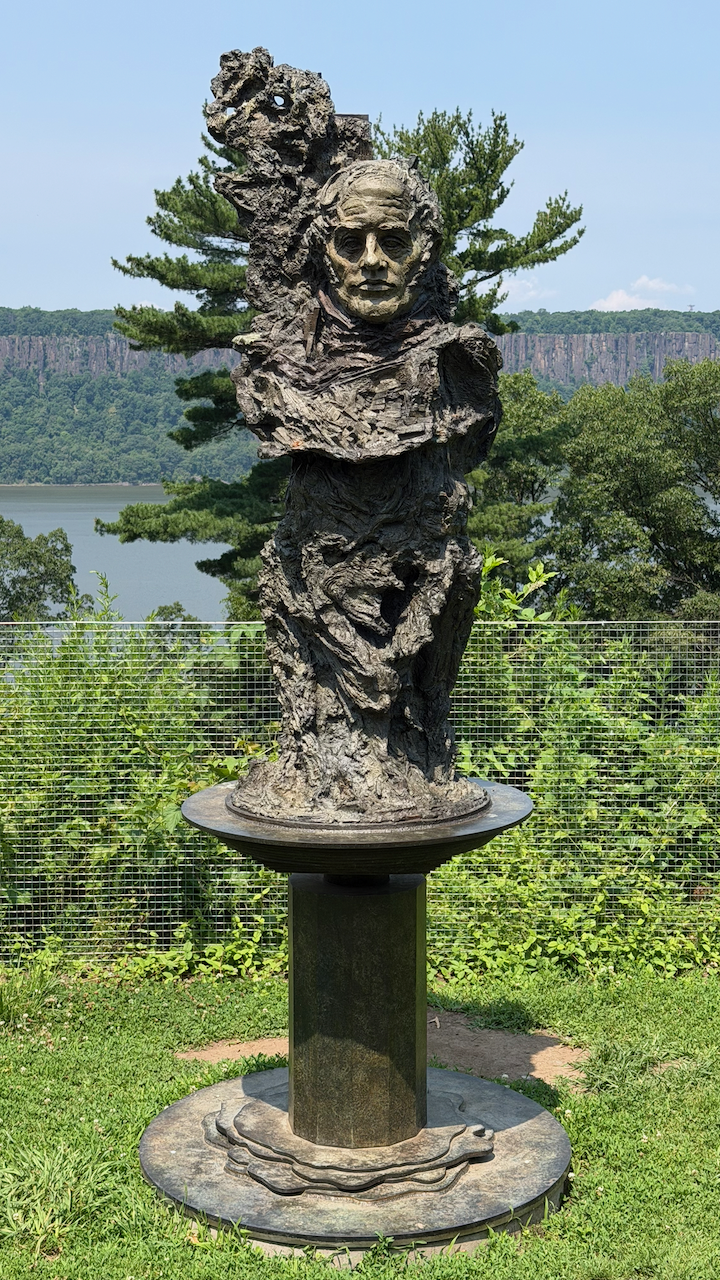
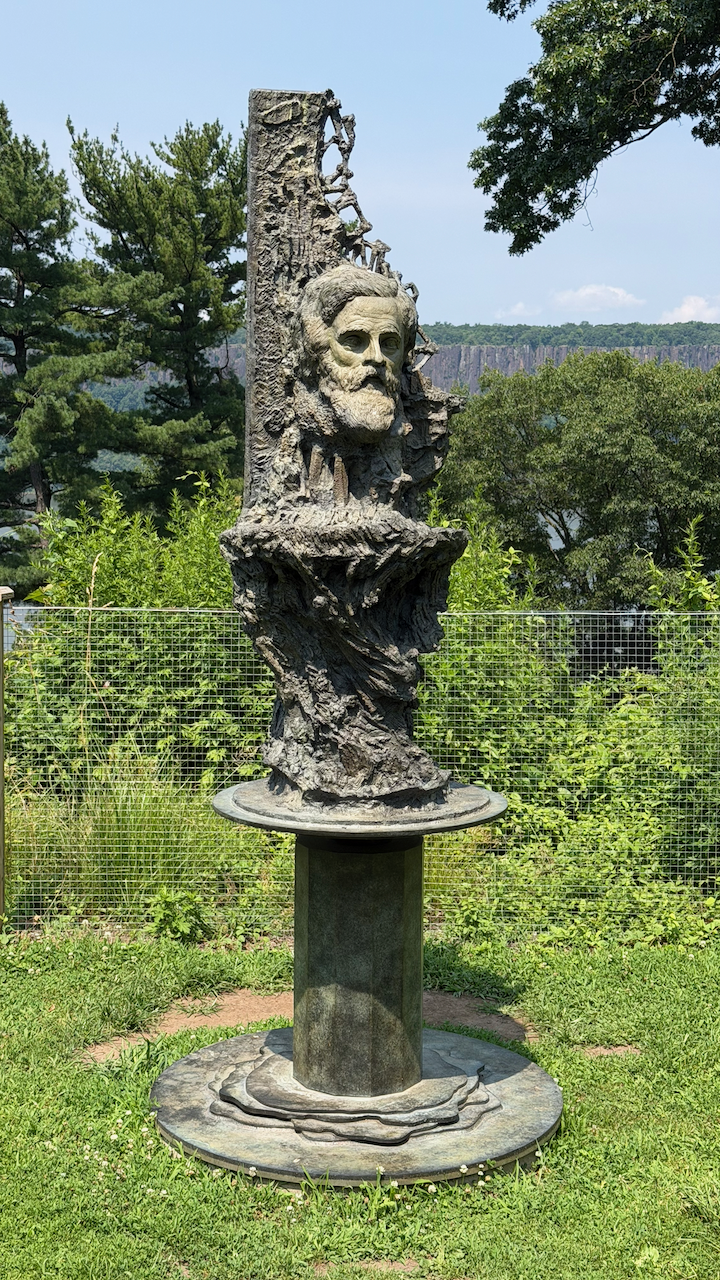
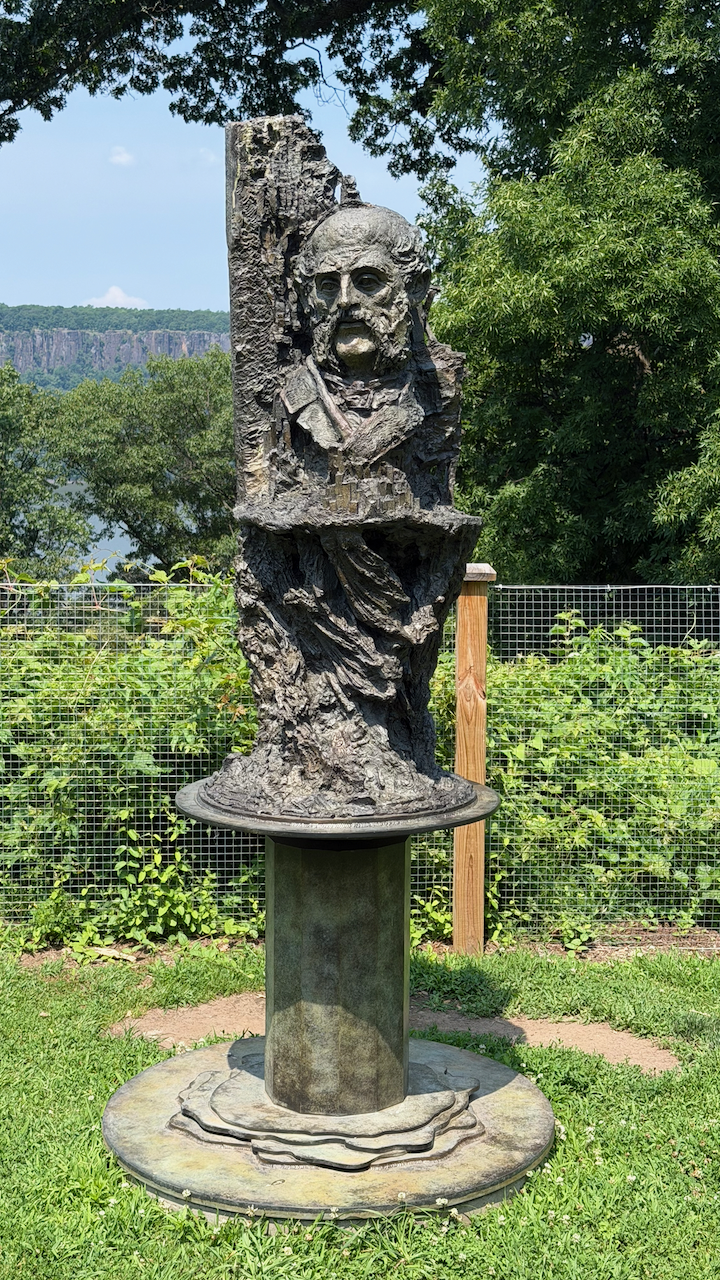
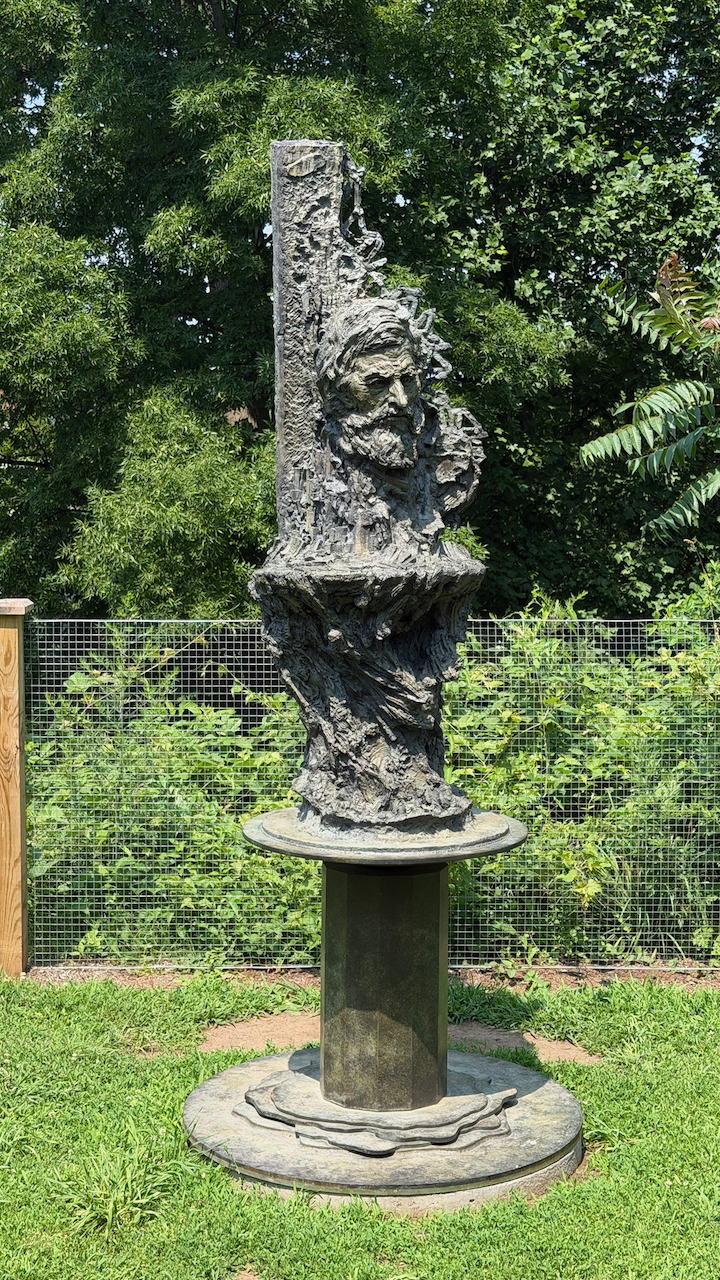
Hudson River School Masters at Untermyer Gardens
-
![]()
Thomas Cole
-
![]()
Jasper Francis Cropsey
-
![]()
Frederick Church
-
![]()
Asher B. Durand
-
![]()
Thomas Moran
-
![]()
Sanford Robinson Gifford
-
![]()
Albert Bierstadt
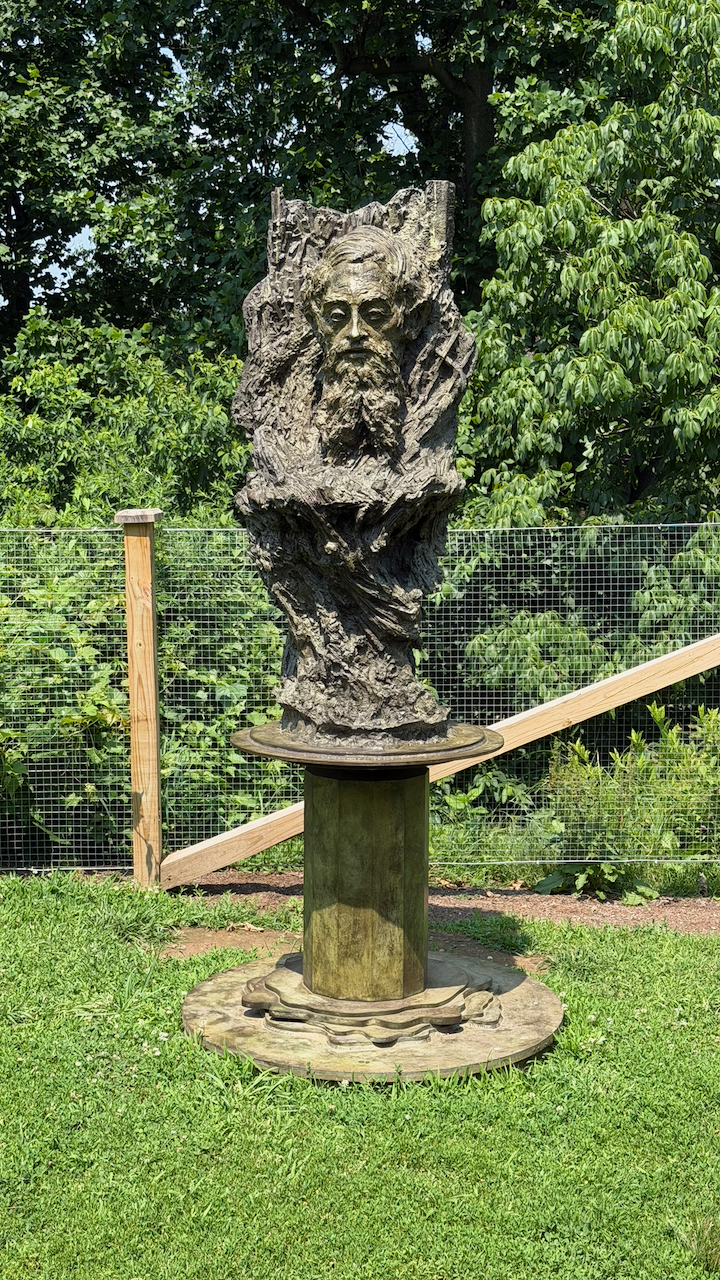
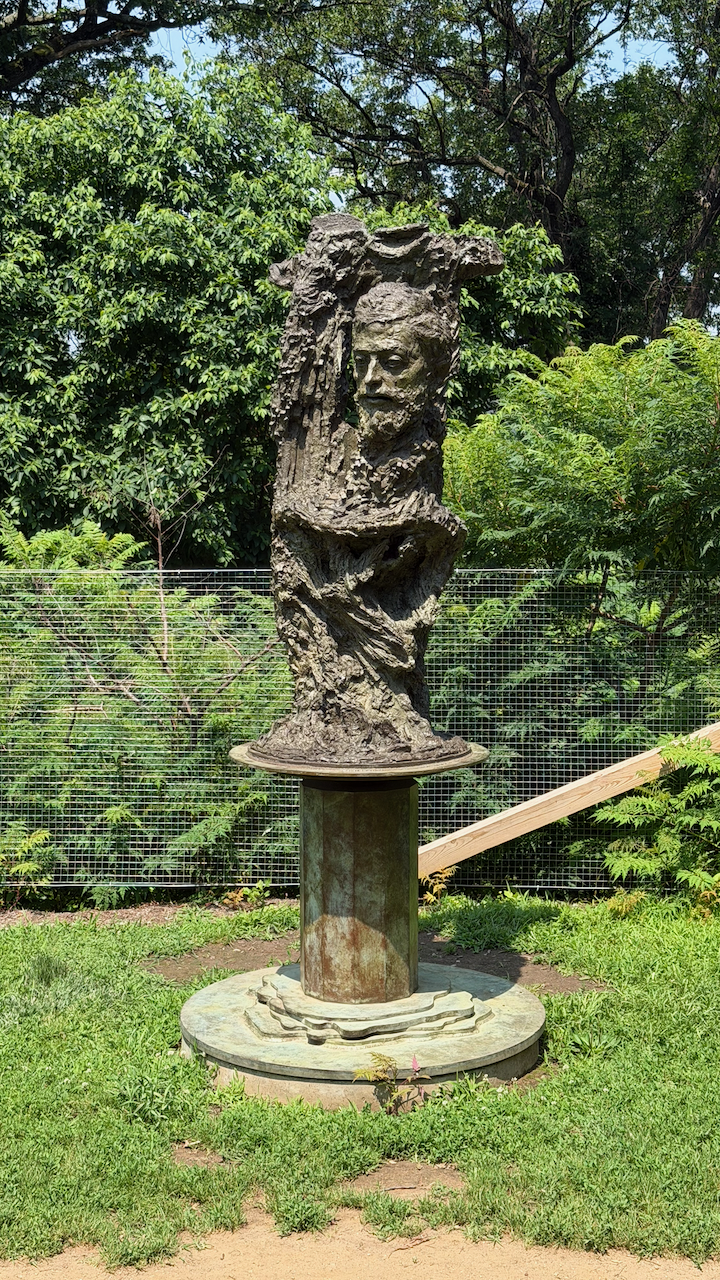
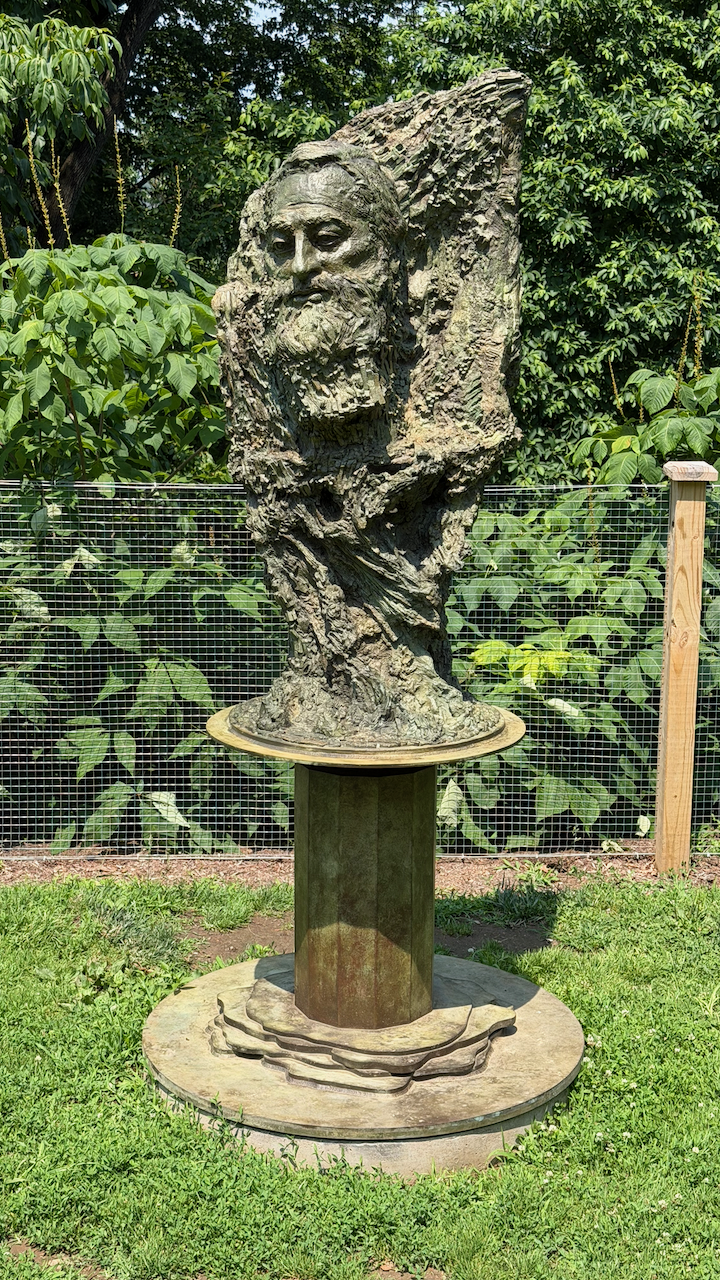
The Belardo Bozetti
A Methodology for the Terracotta Bozetti from Life
John Belardo, 2026
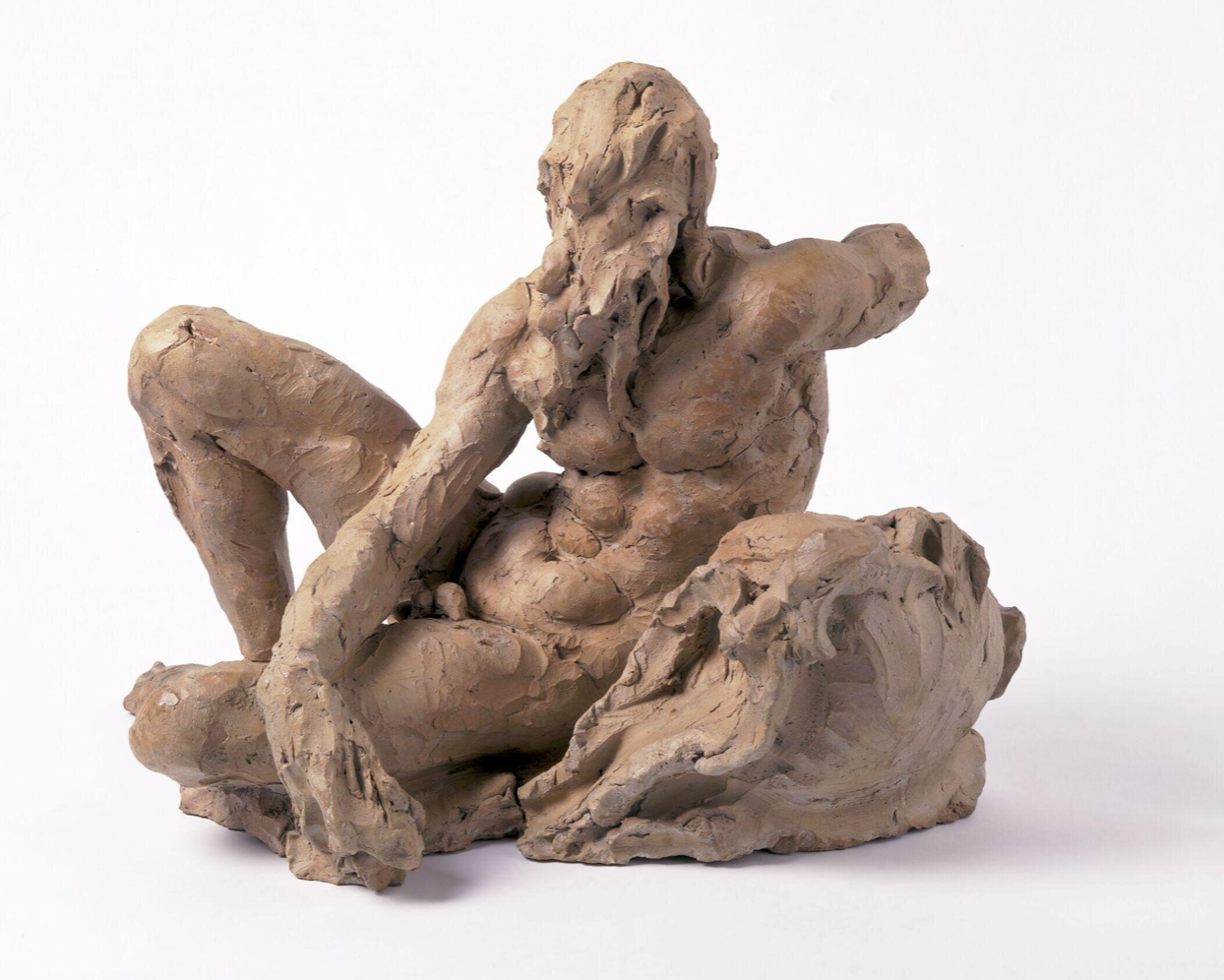
Giambologna, River God, ca. 1580
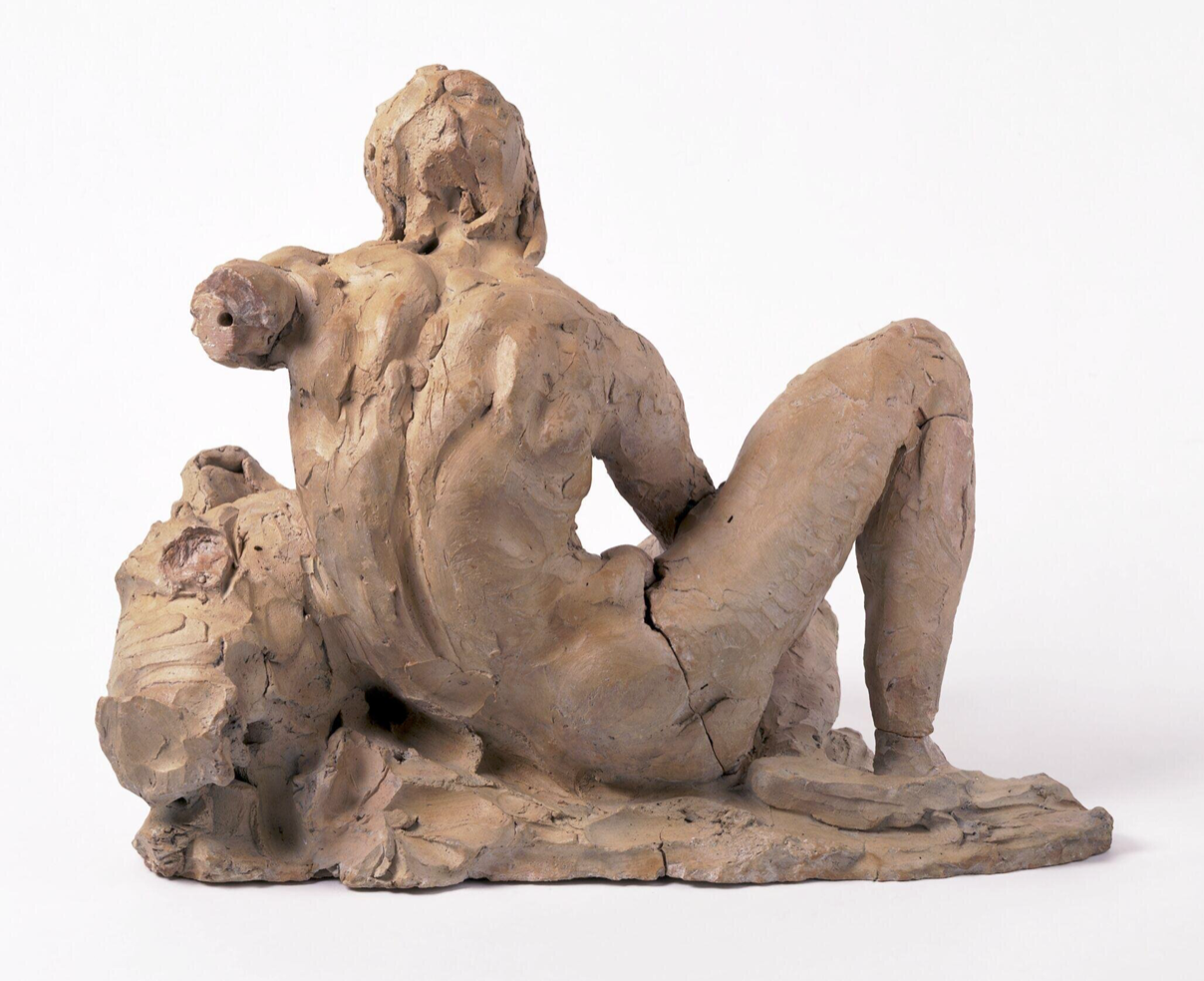
Giambologna, River God, ca. 1580
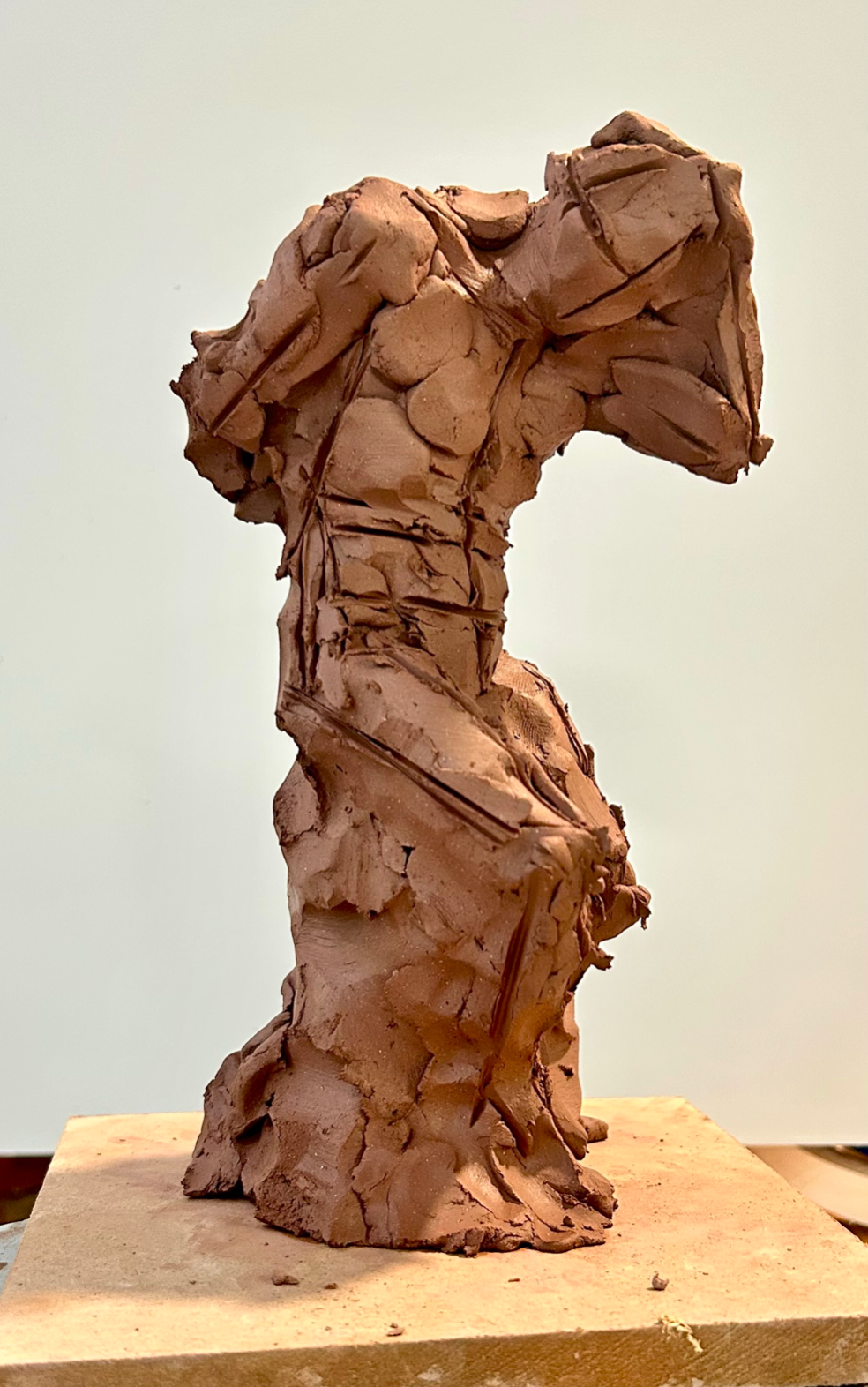
Mud Monster, Mass composition
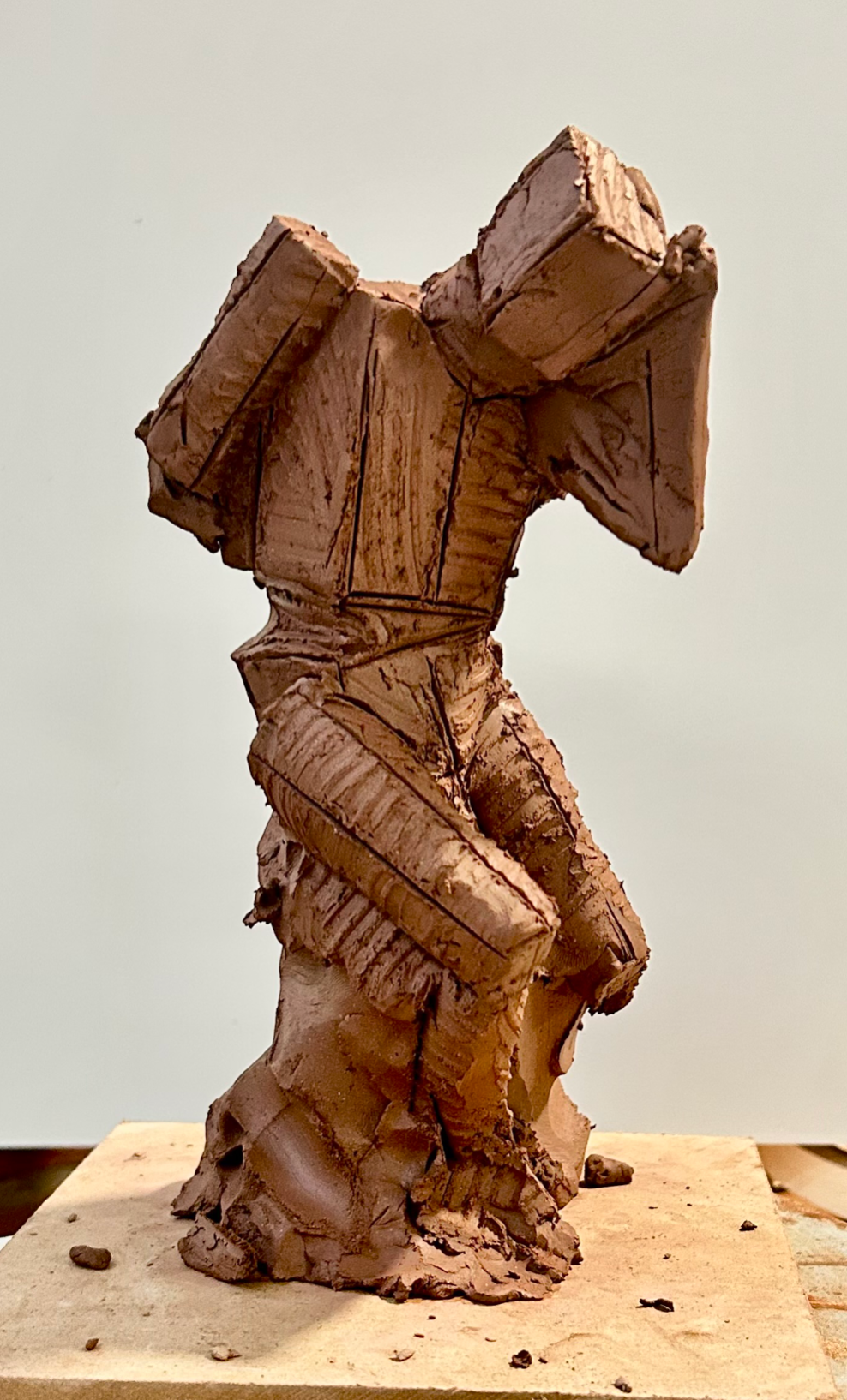
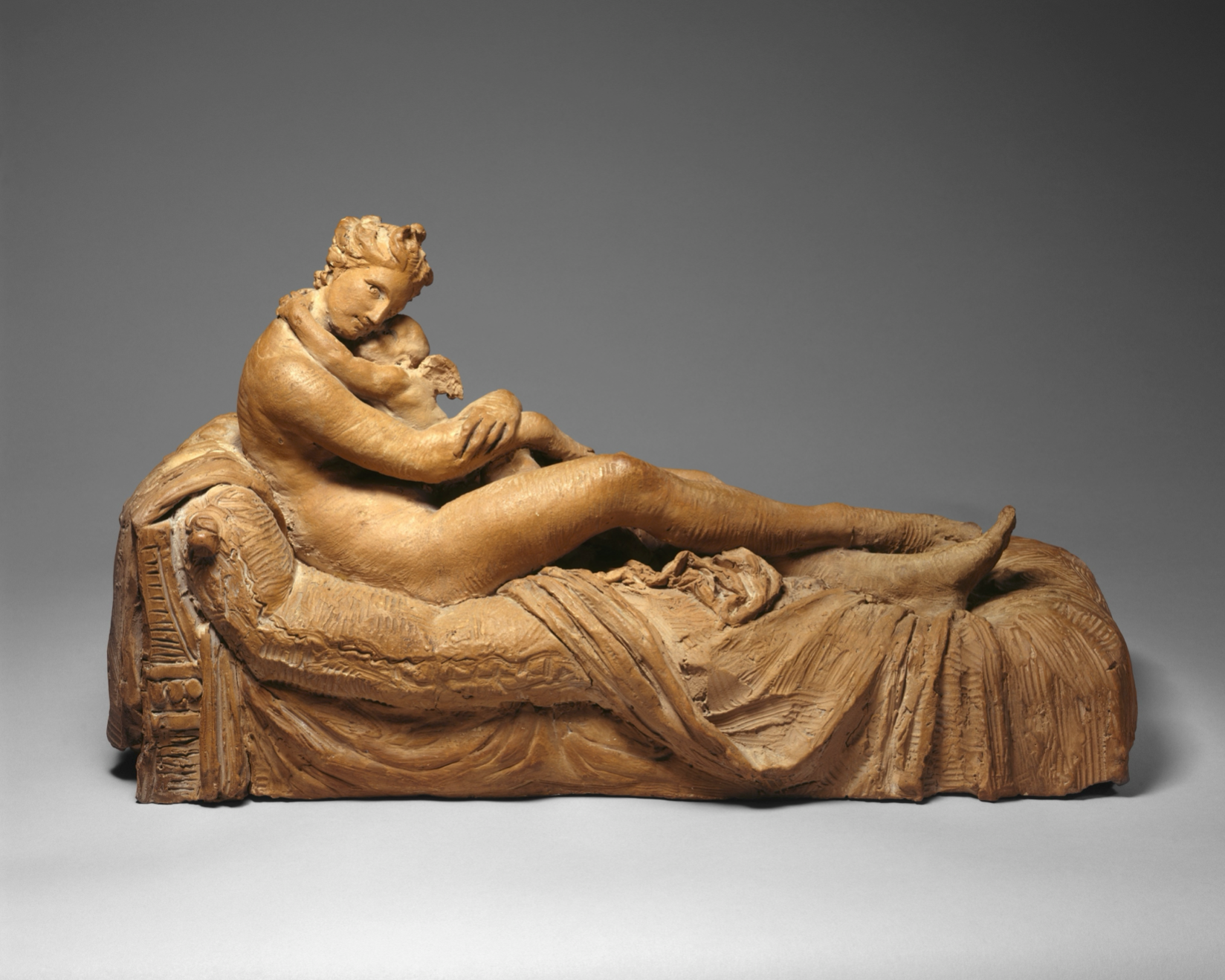
Canova
(Notice the cross contour on the thigh)
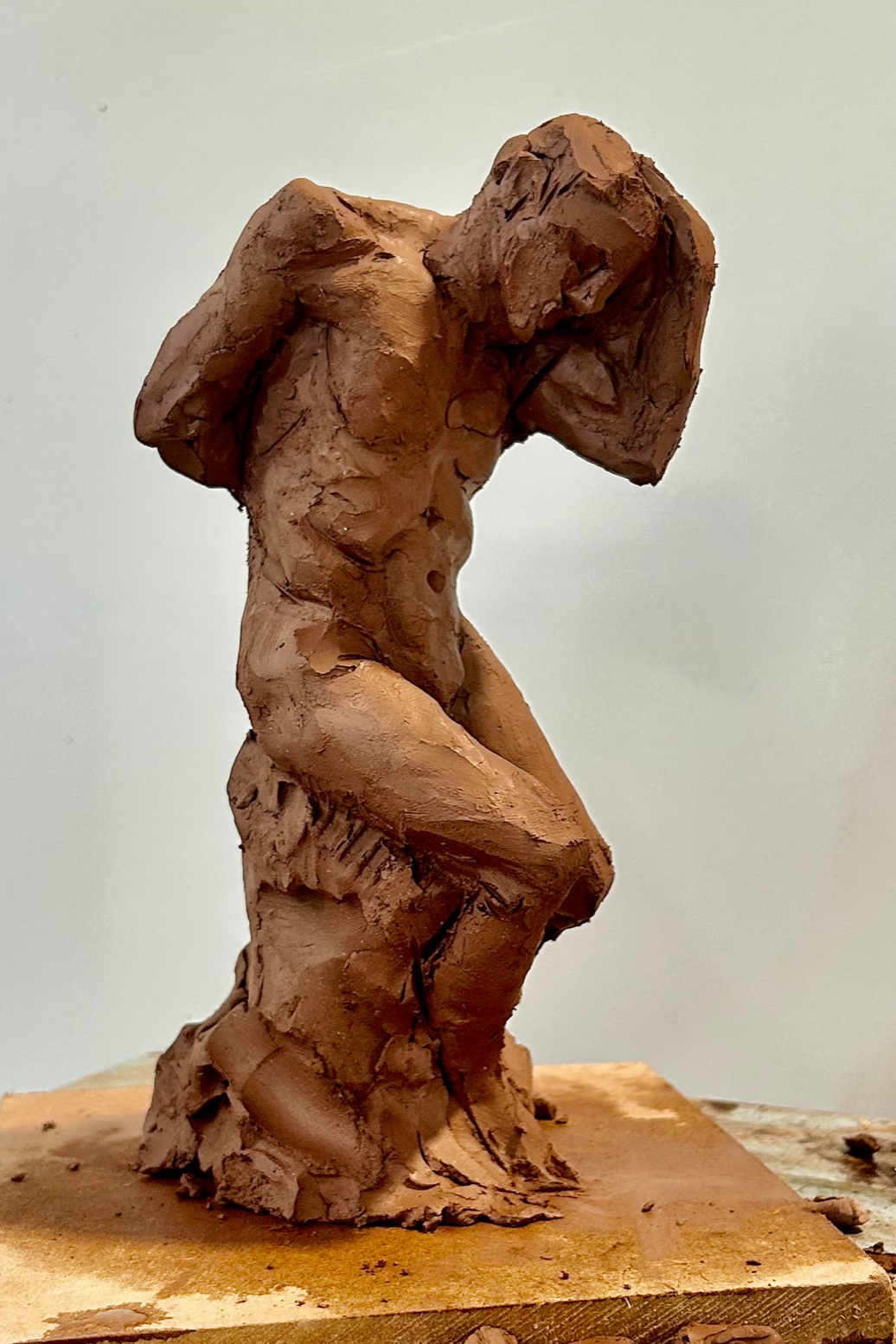
Surface convexities, “Muscle bumps”, Pinching and pilling”
In this essay, I will lay out my methodology for the process of terracotta bozzetti from life, primarily in a class or workshop setting. This is the methodology that I developed over decades of teaching in multiple institutions. I hope that this description will clarify what many teachers have been teaching for centuries, but have not written down.
"When godlike art has, with superior thought,
The limbs and motions in idea conceived,
A simple form in humble clay achieved
Is the first offering into being brought."
—MICHELANGELO, 1545/46, translated by F. Bunnett
What is a Bozzetto?
Bozzetto is an Italian word for a small, loose sketch in clay or wax that a sculptor creates to explore possibilities for larger, more refined sculptures. Historically, the bozzetto form emerged from the need of sculptors to quickly express their thought processes and iterate design ideas. This process requires a medium that is easily manipulated and allows for endless variation. Clay is the most commonly used medium for this purpose. Wax was often preferred for these sketches, but unfortunately it is less permanent, resulting in fewer surviving examples.
The bozzetto process can begin with empirical observation or through imaginative design and organization. The ultimate goal is to inspire new work that leads to larger, more elaborate, well-thought-out, and sophisticated sculptures in a permanent medium. Throughout history many examples of bozzetti have survived, and for this essay I will focus solely on the sketch form and not the more finished “modelli.” While terracotta was used extensively from prehistoric times to create small-scale figurines, it was only during the Renaissance that the bozzetto was recognized and valued as an experimental step before creating more complex permanent works.
“We are told by Baldinucci that Giambologna, in his old age, used to Love to recount a story against himself: how, soon after his arrival in Rome, he took to show the elderly Michelangelo a laboriously finished model, no doubt hoping for his approbation. Instead, the old master squashed it … only to remodel it himself, with a few deft strokes, into a vigorous composition, admonishing the newcomer: "Or va prima ad imparare a bozzare e poi a finire" ("Now go off and learn to model first, before trying to finish” from Fingerprints of the Artist, European Terra-Cotta Sculpturefrom theArthur M. Sackler Collections
What is the Educational Value to a Sculptor?
Life drawing—or modeling from life—serves different purposes for an artist. It can function as preparation for larger, more finished works, or as an exercise in observing nature and absorbing the lessons of beauty it offers. As human beings, we are naturally drawn to the human form we inhabit. Studying that form helps shape our sense of beauty and design, grounded in the idea that the body itself is a guiding ideal—a lodestar of proportion, harmony, and grace.
For the artist, the practice of drawing or modeling from life is akin to an athlete training in the gym or a priest in prayer. It is a discipline we return to regularly, a way of grounding and orienting ourselves. Through it, we resist drifting into our own peculiarities or becoming lost in overly subjective or isolating tendencies.
“True personality is only developed and revealed at the price of being sincere in the face of nature and to oneself; it is then only that we put into our work our own sentiments and emotions and that, so to speak, we create to our own image.
Then our work becomes the reflection of our soul, of our feelings, and it is alone under such conditions of sincerity and knowledge that our creations become personal.” Modeling and Sculpting by Edouard Lanteri
How Do We Observe Nature?
It is often said that “you draw what you know,” a statement that can be defended but requires some philosophical unpacking. Knowledge is commonly understood to take two primary forms: empirical knowledge, which is gained through sensory experience, and rational knowledge, which is developed through intellect, reasoning, and conceptual understanding.
The process of drawing or modeling is, in many ways, a negotiation between these two kinds of knowledge. What we render is not simply a transcription of what we see, nor is it purely an invention of the mind. Rather, form emerges from an interaction between observation and projection—between what is visually perceived and what the artist understands, anticipates, and organizes mentally.
In the study of the human figure, this balance becomes explicit. Artists work from a live model to develop empirical knowledge of proportion, movement, weight, and surface appearance, while simultaneously studying anatomy and geometry as rational systems that clarify underlying structure. Skeletal and muscular systems are understood not only anatomically but also through geometric simplifications—such as spheres, cylinders, and planes—which help the artist comprehend volume, orientation, and spatial relationships. When making figurative sculpture, the artist draws upon both sources: the immediate visual information of the observed body and an internalized understanding of its anatomical and geometric structure. The resulting form reflects not only what is seen, but also what is known—and in this sense, the claim that “you draw what you know” describes not a limitation, but the very foundation of representational practice.
Materials: Why Terracotta?
Terracotta supports an open-ended, experimental, and immediate approach to sculpture, allowing for continual revision and adjustment throughout the modeling process. It is a natural, water-based clay body that can be fired once it has fully dried. Firing is the process by which dried clay is heated in a kiln to approximately 1000°C, causing permanent chemical and physical changes that transform the clay into a ceramic material. Once fired, the sculpture becomes stable and permanent.
The ability to fire the work is essential. The primary alternative method for making a clay sculpture permanent is mold-making, which can be cumbersome and disruptive to the creative process. Mold-making requires the sculptor to interrupt the flow of artistic decision-making in order to engage in a time-consuming and highly technical procedure. Many sculptors find this process unpleasant, and for some it has a lasting impact on their design choices. In practice, artists may simplify or limit the complexity of a sculpture in anticipation of the difficulties involved in mold-making, allowing technical constraints to influence formal decisions.
If we intend to fire a terracotta bozzetto, the use of internal armatures must be carefully limited. While internal armatures are commonly used to support clay figures during modeling, they pose significant risks during drying and firing. As clay dries, it shrinks; a rigid internal armature does not. This mismatch can cause cracking or structural failure as the clay pulls against the non-shrinking armature. For this reason, internal armatures can ultimately destroy a sculpture intended for firing.
Beyond structural concerns, internal armatures also constrain design choices. Even the most flexible armatures impose predetermined orientations and proportions, which can restrict spontaneity and responsiveness during the modeling process.
Terracotta offers additional qualities that further support an open-ended bozzetto practice. One of its most significant attributes is its wide range of workable states, from very wet slip to dense, leather-hard clay. Each stage offers different possibilities for form-making: softer clay allows for rapid, gestural modeling and large-scale movement, while firmer clay supports greater precision, refinement, and detail.
How Do We Set Up? Orientation and Measuring
The primary goal in any empirical observation is objectivity. To achieve this, it is essential to clearly understand the spatial and scale relationship between the live model and the clay sculpture. Often sculptors will measure directly from the model using calipers, and a scale calculation to transfer measurements to the clay sculpture. Because this method of Bozzetti is for small and quick studies, it is impractical to go through this direct measuring process. Instead we will be measuring by an indirect, external method.
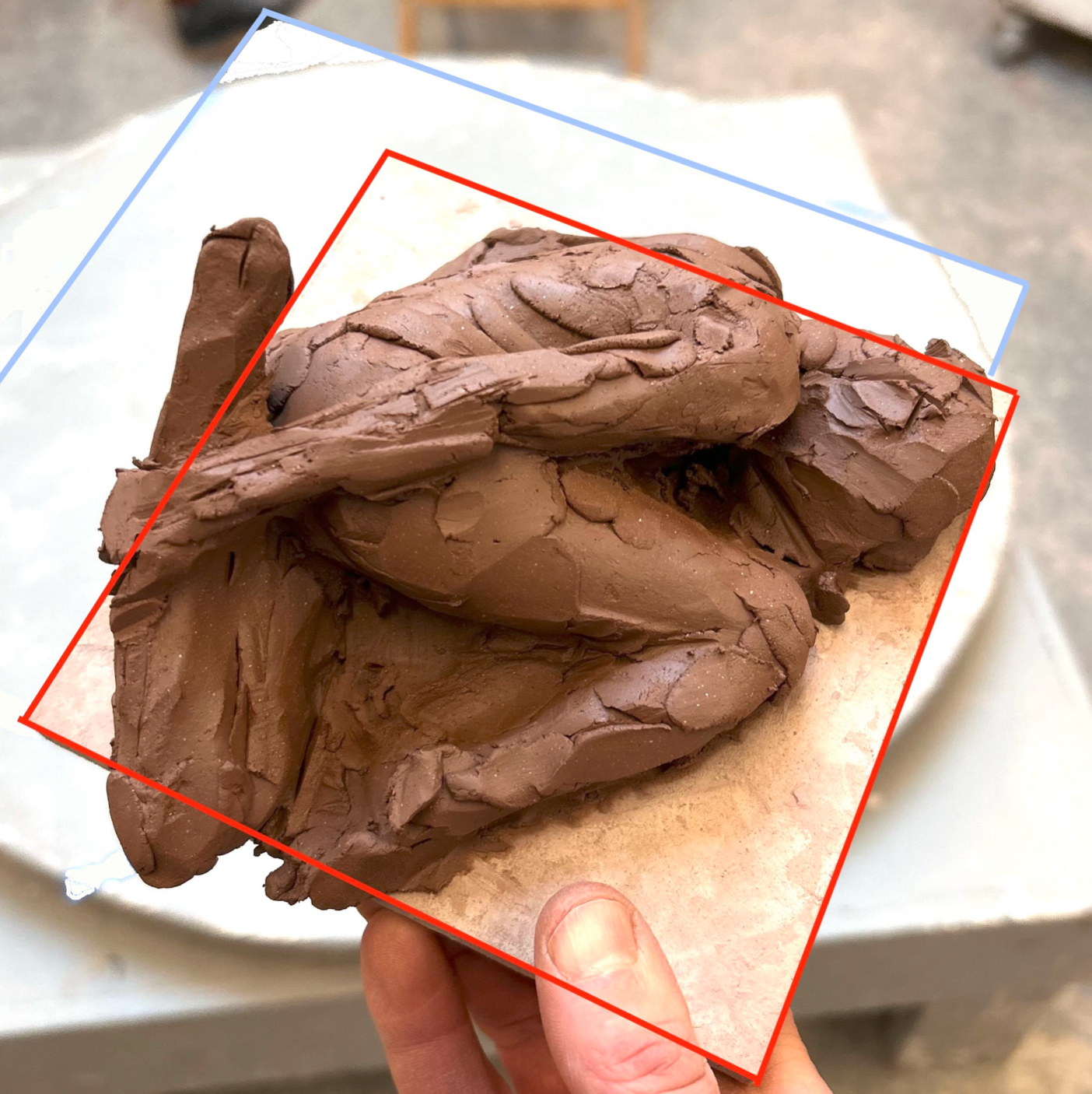
A square reference plane provides the necessary external framework. Although the system operates in three dimensions it begins with a base square to map the the position along the surface, then moves up to locate the hight . In this way the cubic space is defined.
Use two squares: A large plywood square (typically about half the model’s height) serves as the posing platform for the live model and a smaller plywood square is used as the base for the clay model.
The relative sizes of the two squares establish the scale of the sculpture. For example, a 32-inch square paired with a 4-inch square produces a 8:1 scale. The exact dimensions matter less than maintaining a consistent scale relationship between the two.
Plotting the Pose in Space
The square functions as a framing and measuring tool. As the model assumes a pose on the large square, their body occupies a specific location and height relative to its edges and surface. This is especially effective for seated or reclined poses.
Focus on the extremities—such as the toes, knees, elbows, or the top of the head—and observe their positions relative to the square’s corners, edges, and surface. These reference points allow you to accurately plot and replicate the gesture and overall pose in the clay. For small-scale work, this is typically achieved through careful visual comparison and proportional relationships rather than direct measurements with calipers.
This square-based system promotes objective, repeatable observations and helps translate the three-dimensional pose from life to sculpture with greater accuracy.
Consistent Orientation
For accurate comparisons, both squares must remain aligned in the same direction throughout the session. When the live model’s square is rotated, rotate the clay square to match. A reliable method is to identify a specific, easily recognizable edge on the large square and keep the small square parallel to it.
How Do We Model Clay?
Jules Breton's book, Nos peintres du siècle: "The thumb sketch promises everything and realizes nothing.” Quoted by Lanteri
In figurative sculpture, particularly when working with clay, artists rely on three fundamental aspects of form: mass, volume, and surface, to build expressive and structurally coherent figures. These concepts guide the sculptor from the initial rough blocking-in of a human or animal form to the final refinement of anatomy and gesture. For bozzetti, we will simplify this down to a few elements to retain the immediacy and quickness of the process.
What is Mass?
Mass is the raw, physical quantity of clay in a given location. It records empirical information and describes the unformed, malleable material before it has been organized into distinct shapes. In this first stage, the sculpture often resembles a “mud monster”—a nebulous, shapeless distribution of clay. Despite its lack of definition, mass is essential for capturing the overall gesture and pose of the figure. It is at this point that the composition, or what I call the mass conception, is established. Sculptors use mass to determine the body’s general weight, balance, and dynamic energy, allowing them to sense the thrust of the torso, the energy of a limb, the tilt of the head, and the overall coherence of the figure before committing to precise anatomical details. Whether working from observation or from imagination, this first mass conception is primary. In fact, all sculpture can be said to be an “articulation of mass” since this is the primary vocabulary in the language of sculpture. All other ideas are layered on top of this conception of mass.
How Do We Add Mass?
The procedure for the mass conception, or mass composition, starts by building through the addition and subtraction of clay only—adding clay where it’s needed and taking it away from where it’s not. This is a process I call the “pilling and pinching” of clay. Using the square reference plane to plot the position of the model, then recording that position by massing clay. This highly simplified process allows the sculptor to control the clay with as simple a mechanism as possible. Try to resist the temptation to move the clay by pressing, twisting, or stretching; this type of manipulation will cause unintended effects, thereby making the process uncontrollable.
Another consideration in mass is the amount or quantity of clay. As you add and subtract or “pill and pinch,” you are actively considering how much or how little clay you need to affect. In this way, we often start with larger amounts of clay in the beginning of the process and sequence to smaller and smaller amounts as we get closer to the more accurate representation of the mass conception.
In this stage, defined negative spaces, such as the empty triangular space created by the arm when the hand lands on the head, must also be treated as mass. (See illustrations below; note the very limited use of perforations.)
At this stage, it is important not to think in terms of separate body parts, or as if you are constructing by adding an arm here and a leg there, as doing so can cause the figure to appear like a posed marionette or action figure rather than a unified sculpture. I warn against posing for the same reason: we need to remain in a critical mindset, remembering that it is not yet a figure, only lumps of clay that are recording the space taken up by the model.
What is a Volume?
Volume introduces rationality and structural logic to the figure. A volume is a geometric solid—such as a cylinder for an arm or thigh, an egg for the head, or a rectilinear form for the pelvis—that possesses internal coherence. Volumes are typically closed forms and are symmetrical along at least one major axis. Because of this underlying geometry, knowledge of one section or view allows the artist to visualize or project information about the rest of the form. By following simple geometric principles, the sculptor can move the figure into a series of interconnected, logical solids—very much like turning the mass “mud monster” into a robot. Volume provides structure, symmetry, harmony, and rhythm, transforming loose, intuitive mass into a stable and anatomically cohesive figure.
How Do We Transition from Mass to Volume?
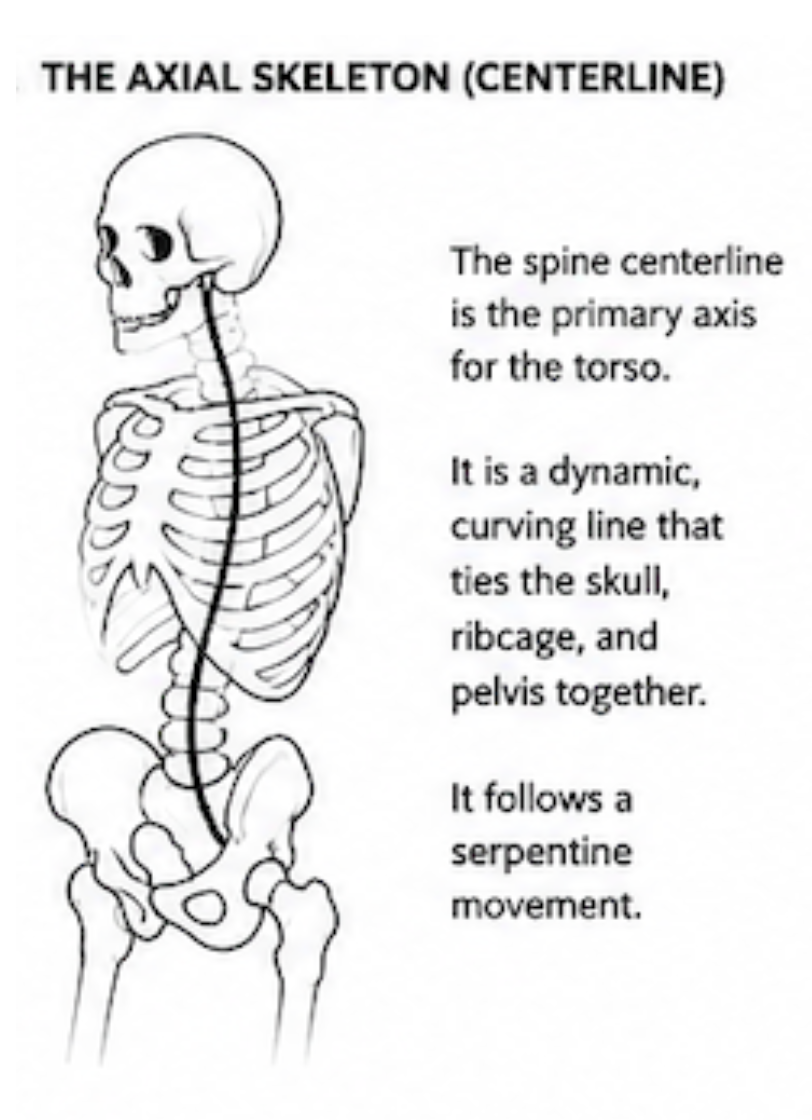
The transition from mass to volume often begins with drawing a centerline or axis line on the surface using a wooden clay knife. This is the line that indicates the central axis of the volume. The line should follow through the symmetrical center; although it is on the surface, it is a projection into the center of the form. The line carries the position in space of the volume, both in inclination and relative angle, as well as information about the beginning and end of the form.
After the line is established, the last dimensional element that needs to be assessed is the cross-section. This cross-section can be any shape, but at least in the beginning it should be simple, like a circle or a square. A circle as a cross-section will result in a cylinder as a volume; a square will result in a rectilinear form. The cross-section of the cylinder is circular; since it emanates from the central axis, we call it a radius. For example, a cylinder can be defined in space entirely with this information: the direction in space, the radius, and the beginning and the end.
Most axis lines are straight, with the exception of the most important one: the centerline through the axial skeleton, or the spine. This line is the dynamic moving line that ties the pelvis, ribcage, and skull together. Close attention to this line from every angle will reveal the moving complexity of the torso. Although this line is a complex curve, it still must follow the law of perpendicular cross-sections. This is analogous to a serpentine movement—cross-sections are compressed on the inside of a curve and spread out on the outside.
Volume is something we learn and practice as student sculptors, but we allow it to remain in the background of our understanding when we become more fluent in the medium. Although we can allow some of the more rigid construction to disappear as we mature as sculptors, it is a good idea to never abandon at least the idea of the center axis line. If we continually reestablish this line, we are thinking in structural volume and producing cohesive figures.
We are not sculpting robots.
Surface is the final expressive layer. It consists of the subtle convexities and transition forms that articulate along the outer hull of the underlying volumes.
Upon examining the model, it becomes evident that within the primary volumes, such as the arm, a series of convexities align with the directional flow of the underlying volume. For instance, the deltoid transitions into the triceps, which subsequently leads to the biceps. While empirical observation may reveal these forms without the explicit identification of each muscle, anatomical study enables the anticipation of these forms and their detection.
While volume establishes the foundational anatomical architecture, surface captures the nuanced interaction of muscle, fat, bone, and skin, giving the figure continuity and physical presence.
When working with small-scale bozzetti, it is important to retain surface energy and a sense of vitality. To do this, we can return to the processes of pilling and pinching. We observe the subtle internal convexities along the volumetric surface—what might be described as “muscle bumps.” These forms can be represented most effectively through the additive application of small beads, or pills, of clay.
The initial critical decision involves determining the appropriate quantity of clay—that is, the necessary mass—for each form. This clay should be refined into a cohesive bead and then gently applied to the surface where the muscle bump is intended. Care must be exercised to avoid excessive pressing or smoothing of the clay. Overworking the surface will result in the collapse of the convexity, flattening of the form, and diminished sense of energy and vitality within the sculpture.
Conclusion.
This methodology is effective when practiced regularly as part of any artist’s creative process. It works well when sculpting from a live model with the goal of learning from nature and avoiding any form of stylization in the sculpture. The model should be given a timeframe that is long enough to develop the bozzetto but short enough for the model to take dynamic and energetic poses. For this method, we employ Rodin’s rule, which states that the bozzetto should not be worked on without the model in pose. This rule prevents the work from becoming laborious. The bozzetto is the epitome of non finito or unfinished.
In figurative clay sculpture, mass, volume, and surface function as progressive stages of realization. The sculptor begins with expressive mass to establish gesture and proportion, organizes the form into clear geometric volumes for structural integrity, and finally refines the surface to convey anatomical specificity and emotional presence. Mastery of this sequence allows artists to create figures that feel both solidly constructed and vibrantly alive.
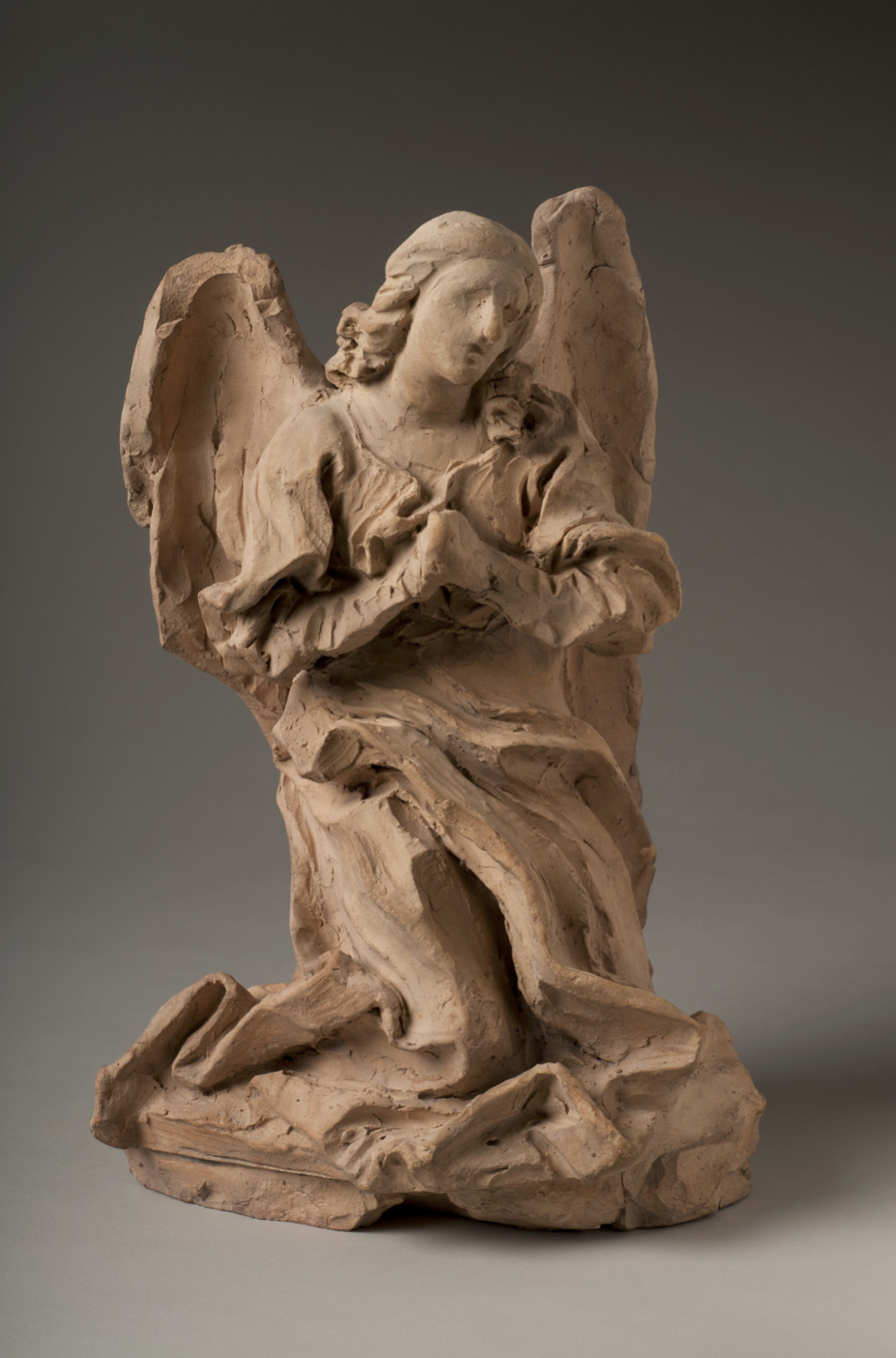
Bernini, Angel Kneeling, Ca. 1650
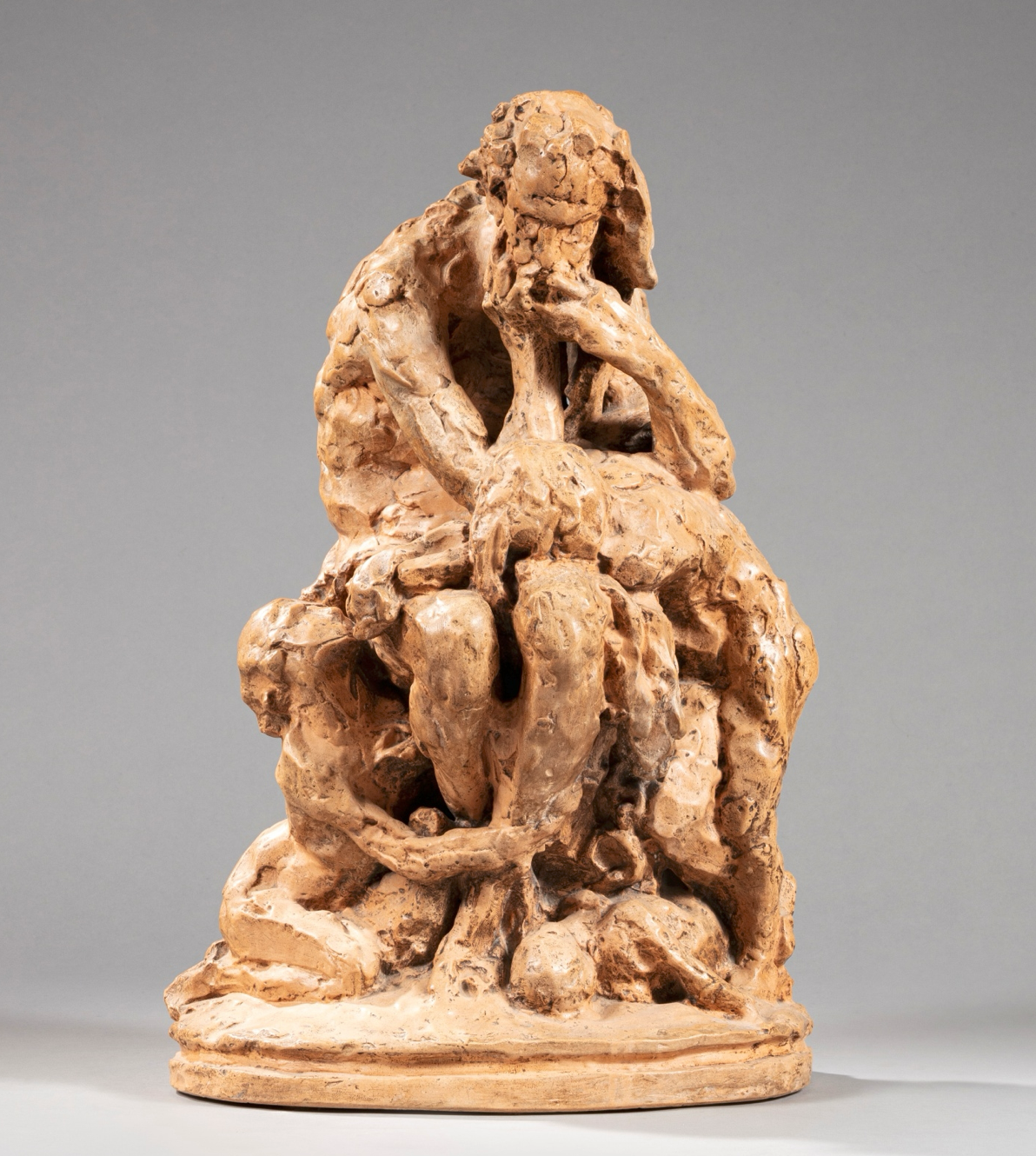
Carpeaux, Ugolino and his Sons, Ca 1860
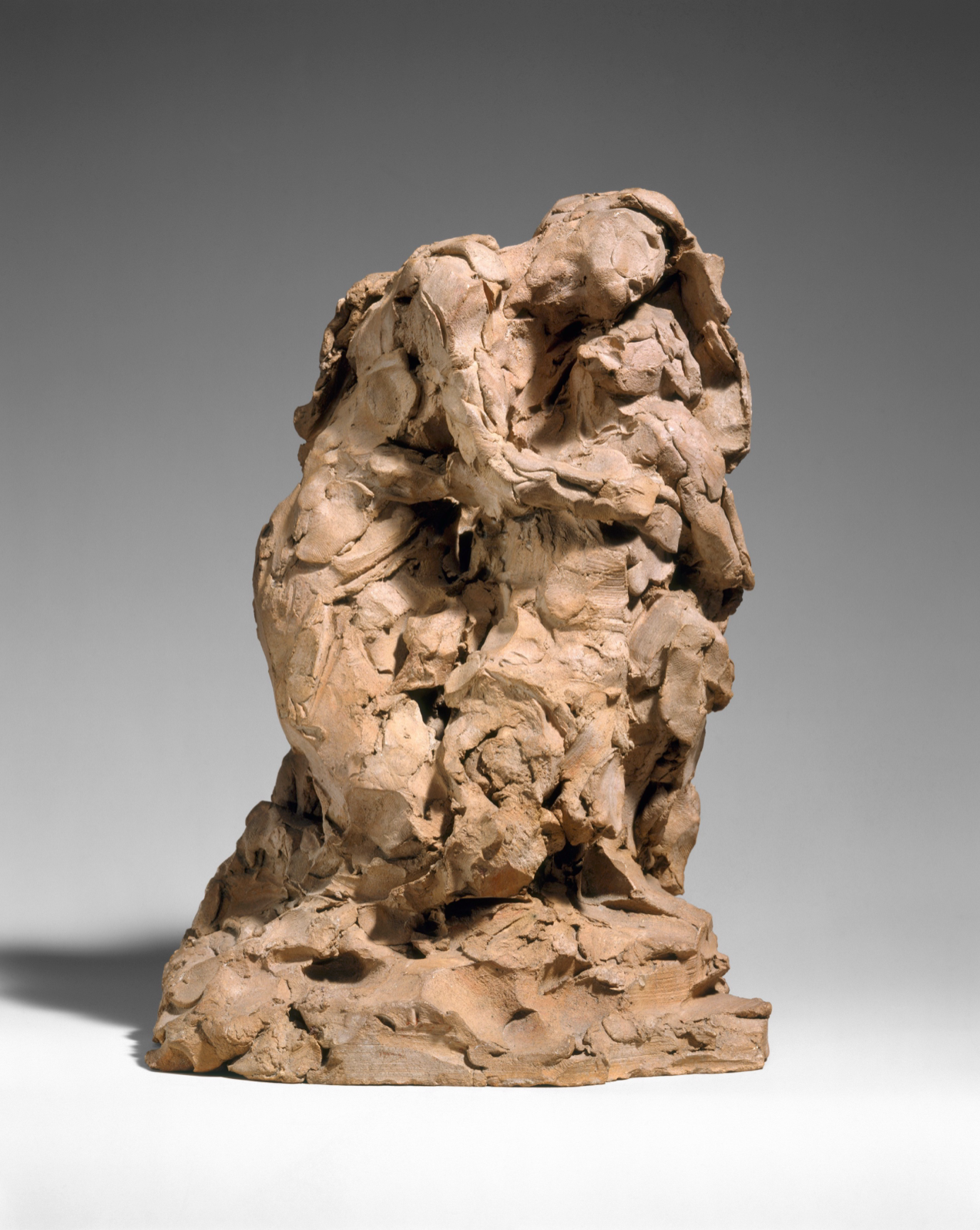
Carpeaux, Pieta, Ca. 1864
Drawing on surface, center Axis linesMud Monster, Mass composite
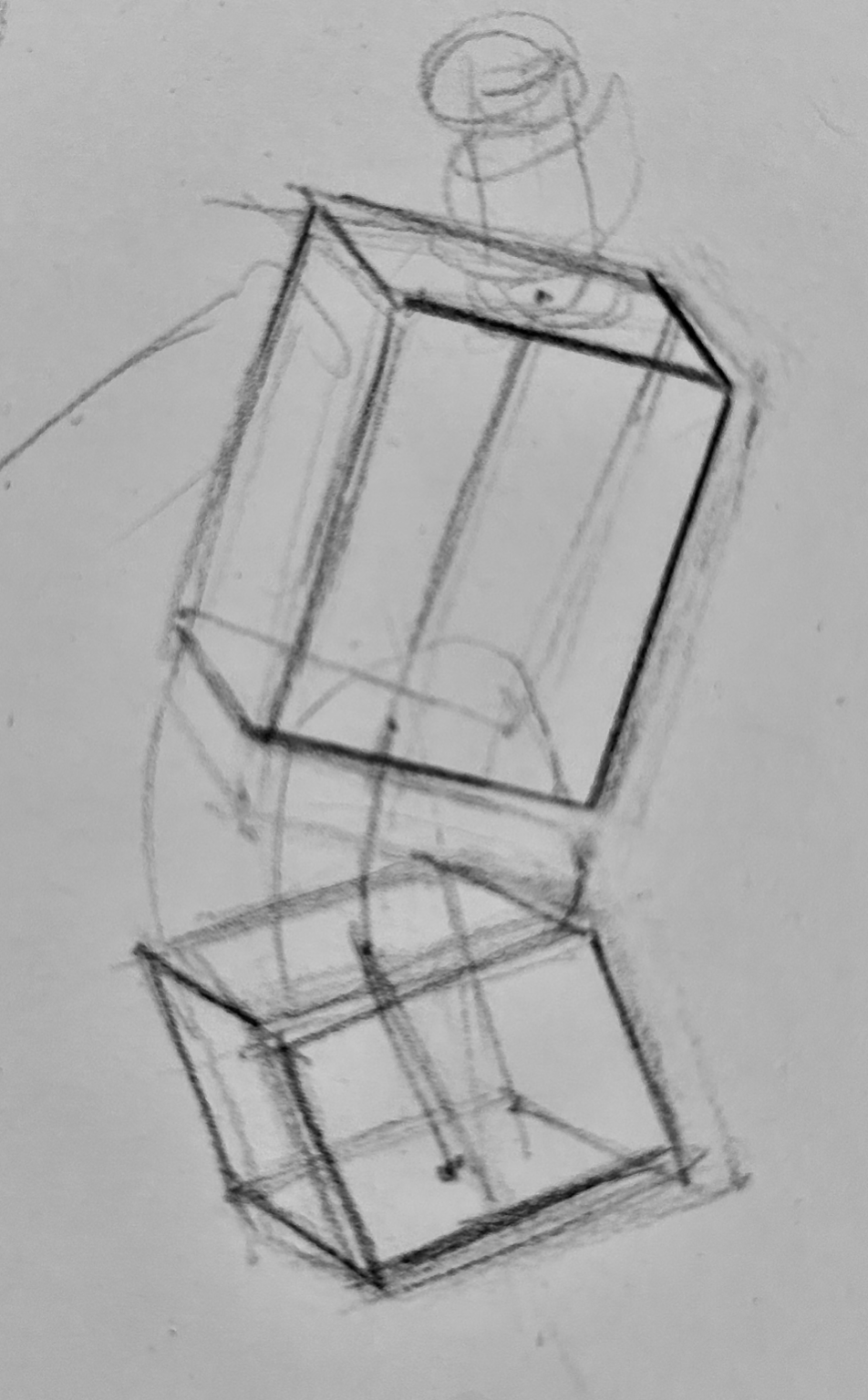
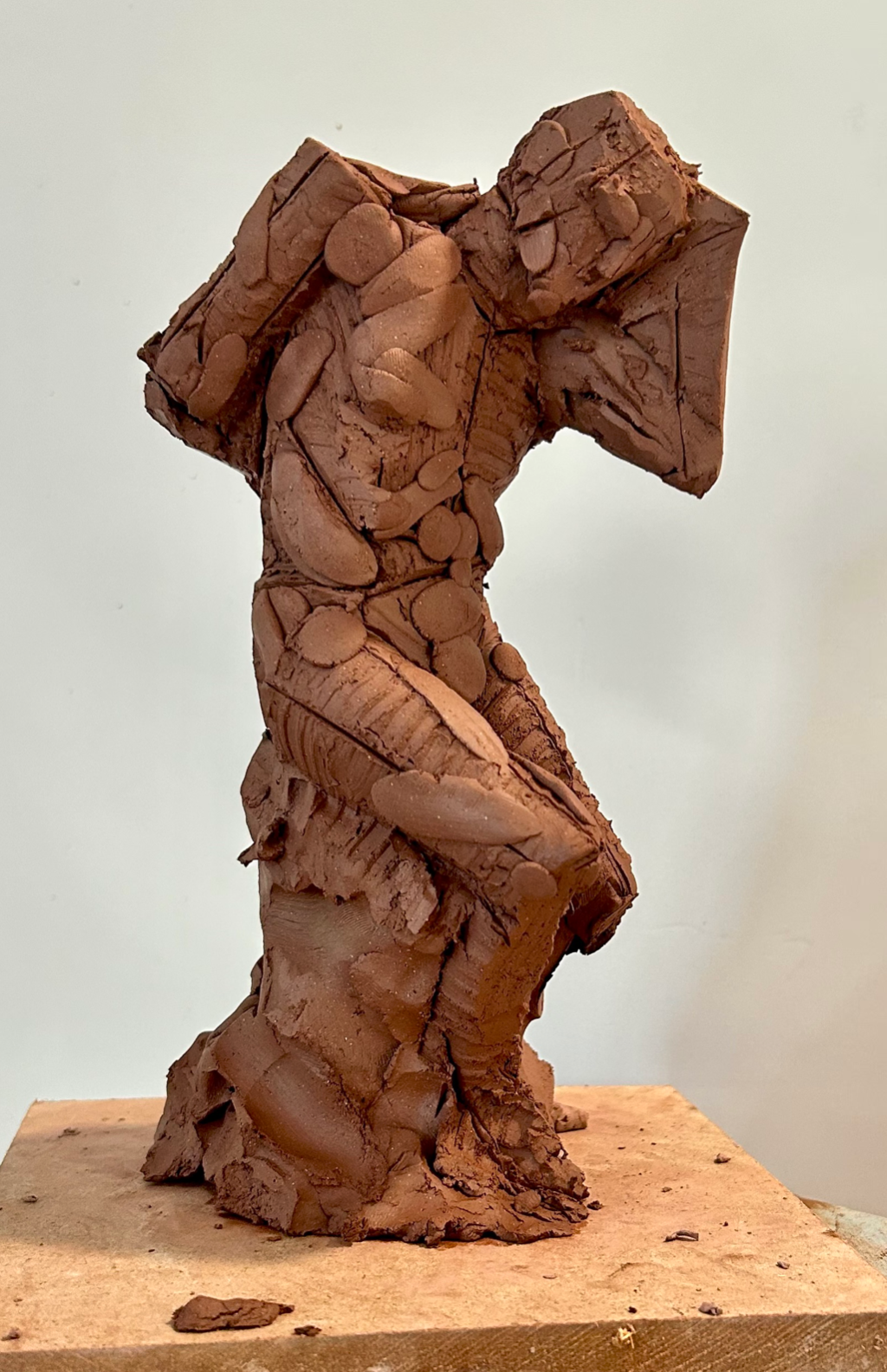
Surface convexities, “Muscle bumps”, Pinching and pilling”
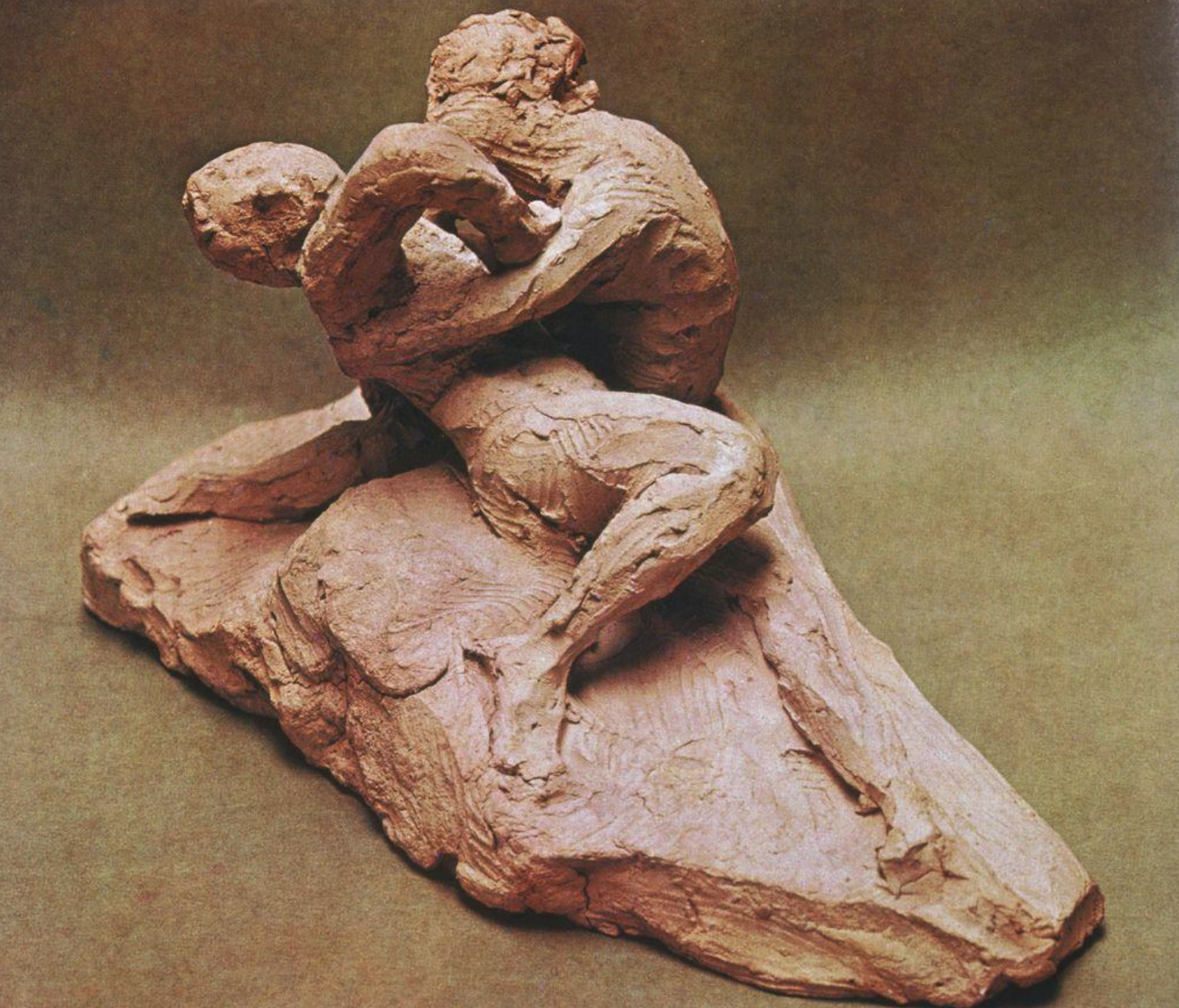
Canova, Bozzetto for Cupid and Psyche, Ca 1850